Sunday, May 18, 2008

Concert on 17 May 2008


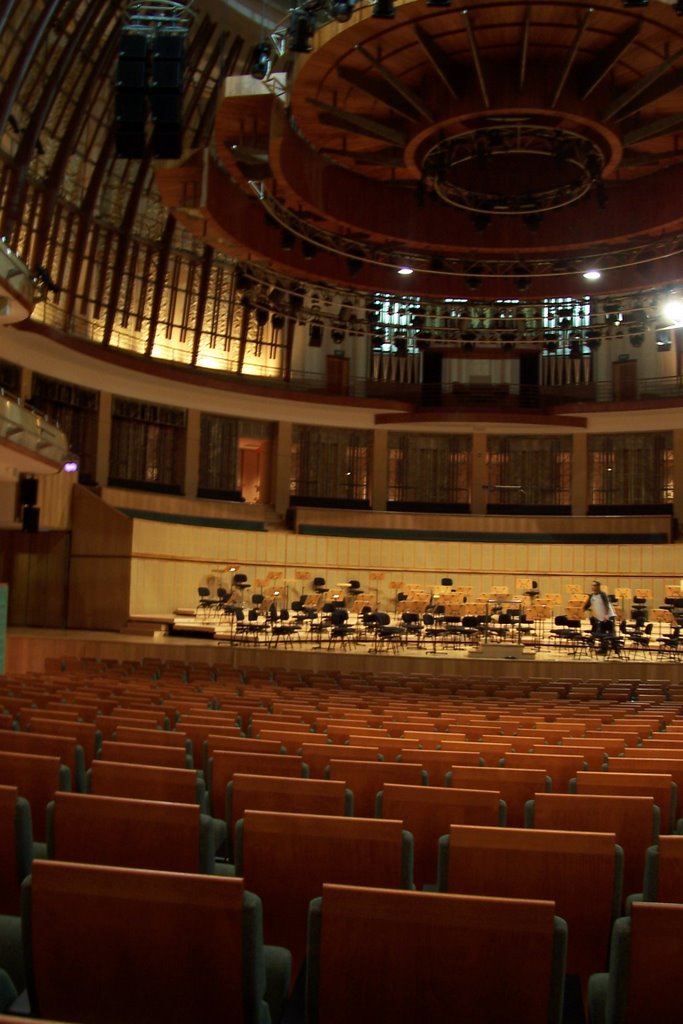
I was resting most of yesterday in the hope to feel better from a flu. In the evening, I took a sneak to catch the Singapore Symphony Orchestra's concert, Masterful Mendelssohn, with one of my friends, Mystic. I am glad that I did. It was a concert worth listening.

Mendelssohn's Violin Concerto in E minor is one concerto that I like. The soloist, Daniel Hope, has generally done a fairly well rendition of the concerto, albeit I love his encore more! The encore, which I still could not make out its title, was played with a beautiful, moving sound that rang the entire concet hall. He would do a wonderful rendition of Mendelssohn's Violin Concerto if he had been a little more relaxed with his use of the right hand so as to produce similar beautiful sound that was produced for the encore. His spiccato could be a little more clearer and his rendition would be perfect. I think maybe he could play short bows for his practices for a start instead of spiccato, and only practise using the spiccato strokes after he could achieve a clearer and articulated sound using short bow strokes on the strings.

The orchestra has a good rendition of Sibelius' Symphony No. 1. Mystic likes it too. The conductor, Ari Rasilainen, knows the symphony very well and he did a good job in leading the orchestra to interpret this symphony in a disciplined yet spontaneous way.

Thanks to Mystic for her company.

***
On the side, my double bass is finally back from repair. Basically, the sound-post was changed as the previous one was too short for optimal performance. I am quite pleased with the fact that my instrument is more responsive after the repair, and more pleasantly delighted that it is now more easy to play at the higher positions as compared to before.

If you have a strings instrument that needs repair or maintenance, do consider Le Diapason. The charges are reasonable for the quality of work that is given.

Saturday, May 17, 2008

Matisse


Brilliant, non-naturalistic colours, applied in a wild fashion. This is my impression of the art movement, Fauvism, that Henri Matisse was associated with.

To get an appreciation of the kind of paintings and artworks produced by Henri Matisse, I would like to point you to a Youtube video put up by sundroid: http://www.youtube.com/watch?v=UwH-eDyWm0k


The Blockbuster exhibition titled Matisse presented by Wing Tai and the Singapore Tyler Print Institute brings viewers to appreciate another dimension of Henri Matisse's art: not the colours, but how Henri Matisse explored the use of line and tone with lithography.

The exhibition helped me better appreciate the fine draughtsmanship of Henri Matisse. If you happen to be at the exhibition, please take time to notice the simplicity and purity of his line works.

I was lucky to have attended the exhibition walkthrough on 10 May 2008 given by Emi Eu. It gave a useful overview to the exhibition. I was later treated to a 30-minutes lithography demonstration by Eitaro Ogawa.

It was an enriching learning experience to see a demonstration of the lithography technique. I got to see how the oil-based image was drawn onto the limestone with the use of a litho crayon, how the image was 'fixed', and how eventually a impression of the image is being obtained.

Matisse showcases Henri Matisse's prints made from 1922-52. It is now being held at the Singapore Tyler Print Institute from 9 May to 19 Jul 2008.

Gallery Opening Hours :
Tuesday-Saturday: 10am-6pm.
Closed on Sundays and Public Holidays.
Mondays by appointment only.
Admission: Free

***
Singapore Tyler Print Institute
41 Robertson Quay, Singapore 238236

Tel: (65) 6336 3663
Fax: (65) 6336 3553
Website: www.stpi.com.sg

Thursday, May 15, 2008

The China Earthquake

A 7.9 8.0-magnitude earthquake had struck in Sichuan province, China, earlier this Monday. BBC News has a special report segment on the recent China earthquake. Perhaps humanity and effective provision of aid are some of the best ways to respond to a devasting natural disaster.

For the folks who would like to extend a helping hand to the victims of the earthquake, here's a piece of information that you may like to know:

Red Cross China Earthquake Appeal

Walk-in donations can be made at the
Singapore Red Cross Society,
15 Penang Lane, Singapore 238486.

The collection hours are:
Mon - Fri: 9.30 a.m. - 5.45 p.m.
Sat & Sun (17-18 May): 9.30 a.m. - 5 p.m.
Vesak Day (19 May): 9.30 a.m. - 5 p.m.

For more information, please call the Singapore Red Cross at 6334-9152/53 or email enquiry@redcross.org.sg.

Instructions for cheque donations, and donations via UOB Internet Banking, DBS Internet Banking and DBS/POSB Fund Transfer are available here: http://www.redcross.org.sg/chinaearthquake_src_donate.htm

**
I happen to have found the URL for those who wish to make a donation to the American Red Cross: China Earthquake Relief.
**

(You may also wish to read Eastcoastlife's Help the Sichuan Earthquake victims.)

Tuesday, May 13, 2008

Experiencing the Peranakan culture at Katong


In the hope to learn a little more about the Peranakan culture after my recent visits to the Peranakan Museum, I went to one of the libraries under the National Library Board to search for related books on this subject.

For myself who is a non-Peranakan, I have found Catherine GS Lim's Gateway to Peranakan Culture to be a book that provides accessible information on the Peranakan culture, specifically that of the Peranakan Chinese. There is a similar book titled Gateway to Peranakan Food Culture by Tan Gek Suan that lends insights to the Peranakan cuisine.


Images source: http://www.asiapacbooks.com


While reading related books could lend me insights to the Peranakan culture, I think learning truly comes alive when one gets to experience the culture. I have had a mini-adventure trying out Peranakan cuisine and viewing objects that are commonly used by the Peranakans when fellow blogger, Eastcoastlife, very graciously showed me about various parts of Katong.

One is likely to ask: "Who are the Peranakans?". According to what I have found on the website of the Peranakan Association Singapore,
the word Peranakan means 'local born' in Malay. It refers to the Peranakan Chinese as well as other Peranakan communities which developed in South-east Asia. These include the Chitty Melaka (Indian), Kristang (Eurasian) and the Jawi Peranakans.

My recent visit to Katong with Eastcoastlife brought me to experience snippets of the Peranakan Chinese culture. From what I have gathered from Catherine GS Lim's Gateway to Peranakan Culture, the Peranakan Chinese community has its origins in the interracial marriages between immigrant Chinese men and non-Muslim women in the 16th century. With this background knowledge, it became interesting to see how elements of the Chinese culture and the traditions common to the natives of the Malay archipelago fuse and influence the culture of the Peranakan Chinese.


The first stop of Eastcoastlife and yours truly while we were at Katong was Kim Choo Kueh Chang - Restaurant. A keen observer would be able to spot elements that hint of Chinese and Malay influences in this restaurant that sells Peranakan cuisine.


As seen in the photo found above, sambal belachan (pounded chillies with toasted shrimp paste) and achar (pickled vegetables) are normally served at every Peranakan meal. The use of belachan is, as best as I understand, integral in Malay and Indonesian cuisines. The use of sambal belachan is probably an example of how the Peranakan cusine is being influenced by the Malay and Indonesian cuisine.

Notice the designs on the crockery. In a Peranakan household, the crockery would often be made of porcelain. The crockery would often bear designs influenced to some extent by Chinese art. However, the designs tend to be more elaborate, floral and colourful than the designs found on Chinese ceramic crockery.


In Tan Gek Suan's Gateway to Peranakan Food Culture, it was said by one of the interviewees that the ayam buah keluak is most representative of the Peranakan cuisine. The buah keluak is the Malay name for black nut. From what I have read, in Peranakan Chinese cuisine, the mature nuts would be cracked and cook with chicken and pork in a spicy stew. The kernel of the nuts would then be scooped out, minced with shrimps and blended with spices to make a paste. The paste would later be stuffed back into the previously emptied buah keluak shells. The stuffed buah keluak would then be cooked with chicken.


Closed-up of ayam buah keluak.

At Kim Choo Kueh Chang - Restaurant, diners will be provided with special fork-like utensils to scoop out the stuffings from the buah keluak. It does take quite some practice to scoop out the stuffings completely from the buah keluak.

At the second level of the Kim Choo Kueh Chang - Restaurant is Kim Choo Kueh Chang - Gallery which showcases Nonya Beadwork & Embroidery, Nonya Kebaya and Nonya Porcelain. I saw this round dining table at the second level.


The Peranakans, as I have read, would usually entertain their guest by treating them to a sumptuous meal at home. When there were a lot of guests, a long table (tok panjang) would be set up. Otherwise, a round dining table would usually be preferred because every diner can reach for the food easily at a round dining table. If you notice the forks and spoons on the dining table, I read that these were usually used when the Peranakans socialise and dine with the Europeans in the past. Now, this is how learning can come alive: when one gets to see and experience what were mentioned in the books.

If what you have read in this post interests you, you may wish to read the two books that were mentioned in this post or any other books on the Peranakan culture. You could also visit the Peranakan museum to catch a good glimpse of the crockery used by the Peranakan. Better still, experience the Peranakan culture for yourself.

My words of appreciation to Eastcoastlife for showing me about the Katong area. I appreciate her company and hospitality.

**
References:
- http://www.peranakan.org.sg
- Lim, Catherine, G.S. (2003). Gateway to Peranakan Culture. Singapore: Asiapac Books.
- Tan, Gek Suan. (2004). Gateway to Peranakan Food Culture. Singapore: Asiapac Books.
Monday, May 12, 2008

Keep safe

Yesterday, one of my younger brothers pleasantly surprised me by getting an apple strudel for me as a belated birthday gift. Many thanks for the apple strudel and the kind thoughts that came with it.

This brother of mine is now in Brunei for training for a few weeks. I wish him a safe trip. Keep safe brother.

Saturday, May 10, 2008

The priceless gifts


One of my good friends, Mystic, very thoughtfully and kindly treated me to lunch at Central which is located along my favourite river, the Singapore River.

We had initially arranged to meet at Chinatown area but thoughtful Mystic suggested to change the meeting venue to Central as it was nearer to the Singapore Tyler Print Institute which I had intended to visit after our meet-up. What's more, she surprised me by turning up at least 45 minutes before our scheduled meeting time. Thank goodness that I was early too so that she need not wait too long.

Mystic was obliging to my preferences for food and went the extra mile to queue for and order the food. I felt touched by Mystic's kind thoughts and her good company. These are priceless gifts that cannot be bought.

Many thanks to Mystic for being a confidante, counsel and friend. Thank you for your priceless gifts this birthday week of yours truly.

Friday, May 09, 2008

Sightseeing: Geylang and Katong


I needed a break from work, and took leave to sightsee parts of Singapore. Eastcoastlife very graciously and generously made time out to show me about various parts of Geylang and the Katong.

Along the way, before the start of the journey, I took a photo of the ixora (a flower) that I had seen near our meeting place. I have found the red hue of the flower to be very attractive against the bright sunlight of the tropics.

She showed me the places to get crispy roast pork and roast duck, as well as a place where the professional cooks would get their sauces and condiments from. This information may come in handy one day.

I was attracted to the architectural designs of some of the shophouses that we saw along the way. For myself who lives in a flat, a tour about Geylang was refreshing for I was treated to shophouses of various designs. A number of the shophouses in the area were built before the second World War.


We also saw a lot of red lanterns in the Geylang area. I could not figure out why one shop which worships the God of Fortune has a lot of red lanterns all around its perimeter. Eastcoastlife said that it could be to attract the attention of passerbys. That sounded very probable.

Eastcoastlife pointed me to the 'cool noodles' which was prepared like a salad. I was told that in China, this dish is a common street-food. Unfortunately, the 'cool noodles' that we had was not the authentic 'cool noodles'. The authentic version should be translucent. Neverthless, at least I have a glimpse to one of the street-food commonly found in China.


Much later, when we were at Katong area, I could not help but take photos of the former Grand Hotel. It looked more deserted-looking than when I saw it about more than a year ago on my walk-about the Katong area. Anyway, I was drawn to its isolated, worn-out and yet majestic front. Hopefully my snapshot below has captured my reactions to the Grand Hotel.


For the remaining part of our adventures about the Katong area and our lovely lunch at Kim Choo Kueh Chang - Restaurant / Gallery, I shall not blog in this post. I am hoping to write a post about my sightings that are related to the Peranakan culture in another post. Please stay tuned for the updates.


Over lunch, Eastcoastlife filled me in with information about the funding support for training offered by the Singapore Workforce Development Agency (WDA). For Singapore citizens and Permanent Residents who are looking for subsidies for training programmes to improve their employability and enhance their skills, it is worth the time to look at the various services and programmes offered by WDA.

My heartfelt appreciation to Eastcoastlife for showing me about the Geylang and Katong area. Thank you for sharing your knowledge and experiences with me. It was a memorable day of sightseeing. Thank you Eastcoastlife.


(Also see Eastcoastlife's posts: Things to do in a red-light district, Sichuan Cool Noodles.)

Thursday, May 08, 2008

8 May 2008


I took leave from work today to send my double bass to the Luthier for repair. The real reason is that I needed a break from work to recharge. Anyway, the sound-post needs some fixing to get it to an optimal position. I hope the repair would help improve the sound of my double bass. Somehow, my ears tell me that although it is just a very average double bass for students, it has not been reaching its potential because of its set-up.

The Luthier is someone who is trustworthy and reliable so I look forward to hear some improvements in the sound quality of my instrument. Meantime, I have to get used to many days without a double bass to practise on at home.

Rather than walking about to sight-seeing though I very much wish to do so, I headed home after borrowing a few books from the library. Food for the mind is as good a treat as beautiful sceneries. I shall allow my body to rest so that it can feel better soon.

In the evening, my family had dinner together. It has been a while since we had dinner together.

Meantime, many thanks to the greetings and wishes from various friends: xiaofen, ML, SH, JL, JQ, Ins., XS.

One of my friends, Trinket Addict, brightened my day with a Sunshine Bag Charm. I like the colour combinations of the charm and the effects of sunshine shining through the charm. If you like handmade accessories made from charms, beads, stones and crystals, you can contact Trinket Addict for purchase enquiries.

Wednesday, May 07, 2008

I wish for good health


I wish for good health, good luck and wisdom.

The doctor said that I have a throat infection. I hope I can recover soon enough.

Monday, May 05, 2008

Happy Birthday to Eastcoastlife


It was Eastcoastlife's birthday recently.

Here's sharing a lovely rendition of Variations on the Birthday Song performed by American violinist, Rachel Barton Pine. I very much admire Rachel Barton Pine's musicality. I hope that the music will bring Eastcoastlife some delight and inspirations on her birthday.

To celebrate this occasion, here's my humble rendition of the birthday tune played on the double bass specially for Eastcoastlife:
http://www.youtube.com/watch?v=XCpb6M1bWQ8

"May your wishes come true, Eastcoastlife."

Sunday, May 04, 2008

Week 18 of year 2008 on the double bass

27 Apr 2008, Sun: I sight-read the second and third movement of Dittersdorf's second concerto. Much of the time was then spent practising the first movement from the concerto. Playing this concerto in some ways challenges me to deal with the self-doubts and frustrations of not being able to produce the sounds that I would like when playing in the higher positions. It is prompting me to address the set-up issue, it seems.

I sight-read a new exercise on the double bass. Time was also spent playing the first and second movement of Marcello's Sonata in G major from memory.

28 Apr 2008, Mon: I played tunes from Hartley's Double Bass Solo Book One, and played selected passages from the first movement of Dittersdorf's Second Concerto.

29 Apr 2008, Tue: Double bass lesson took place in the late afternoon. I was using my own instrument for the lesson. Sight-reading pointed out my weaknesses. I needed more work on playing uncommon rhythms and accidentals by sight.

I continued to work on the first movement of Dittersdorf's Second Concerto. I need a focused articulation.

30 Apr 2008, Wed: I played on the double bass, playing one same tune in various fashion. The goal was to capture a good recording of the playing.

1 May 2008, Thu: It was a public holiday. Is it due to poor health, I did not seem to be focused when I was practising. I sight-read one exercise, and then worked on the first few bars from the second movement of Dittersdorf's Second Concerto. Afterwhich, time was spent practising some parts from the first movement of the same concerto. I need more focus.

3 May 2008, Sat: I sight-read an exercise, and continued to practise the first movement of Dittersdorf's Second Concerto. I wish for more focus during the practice!

I shall declare a break from double bass practising for the week/s to come. If I do get to practise, it will be a bonus. My double bass needs to be sent for repair, and I wonder how long this would take. The Luthier isn't free this weekend so I would visit him middle of the week.

Saturday, May 03, 2008

Blogger now schedules future-dated posts

Dear fellow users of Blogger, if you take some time to read your dashboard, you will find out that Blogger now schedules future-dated posts.

This means users of Blogger can now schedule post publishing. This will come in very handy for those who wants to post something on a certain date but can't be at the computer to publish the post. Do check your dashboard for more information.

Friday, May 02, 2008

Peranakan beaded shoes

While I was surfing http://www.peranakan.org.sg to learn more about the culture of the Peranakan Chinese, I came across a Youtube video put up by bristow47. Although short, this video lends insights to the art of making Peranakan beaded shoes.

The video "features a traditional Peranakan beaded shoe-maker, Mr Robert Sng". To view the video, please visit http://www.youtube.com/watch?v=kivqEOCx-uw

I have embedded it here for your convenience. Credit goes to bristow47 and his team for putting this video together.


Meantime, to learn more about the culture of the Peranakan, you may wish to visit the Peranakan Museum, Singapore, this weekend. There will be a series of events to celebrate the opening of the museum over three weekends from 26 April to 11 May 2008.

Thursday, May 01, 2008

The blogger's block

Is it the blogger's block that I don't feel like blogging of late? I realised that I have come to a phase when I don't have as strong an urge to blog.

It is Labour's Day today. I am not feeling in good health and had to spend most of the time resting at home to recuperate. Thank goodness that home is quiet today because no one is watching the television.

Talking about television, according to wikipedia, the television has been commercially available since the 1930s. In Days of Black and White Television in Singapore, by Lam Chun See, it was said that television made its debut in Singapore in the year 1963.

Strangely, television did not draw my interest nowadays. There do not seem to be any programme of particular interest to me. I remember that when I was a young child, I used to enjoy watching cartoons on television. Now, I don't. People evolve, I suppose.

Meantime, wishing everyone good health.